ETR Insights recently caught up with the Director of IT for a global logistics enterprise, who shared their strategic approach to navigating today’s most complex IT challenges, from leveraging single-cloud providers like AWS, Microsoft, and Google to streamline operations and meet global compliance requirements, to cautiously exploring generative AI use cases. The conversation also delves into workforce localization strategies, the adoption of AI tools like Dataiku and Databricks, and the use of robust security solutions to safeguard cloud environments.
Key Insights from the Interview
For this global logistics enterprise, the multi-cloud question is a key strategic challenge. Faced with rising IT costs and the complexities of global data regulations, the company has prioritized consolidating operations within a single cloud provider to simplify workflows, scale operations, and reduce expenses. According to our guest, multi-cloud strategies often come with unnecessary complexities: "If you do a multi-cloud, now you're quadrupling that thing… you’re creating another cloud instance in every region to support disaster recovery, which doubles your footprint."
This streamlined approach is critical as global data protection regulations tighten. The company has leveraged cloud providers like AWS, Microsoft, and Google to achieve compliance while managing costs effectively: "Countries like China, Russia, and India have stringent data sovereignty laws… It’s much easier if you invest in a cloud provider where you can spin up a quick data center and demonstrate compliance."
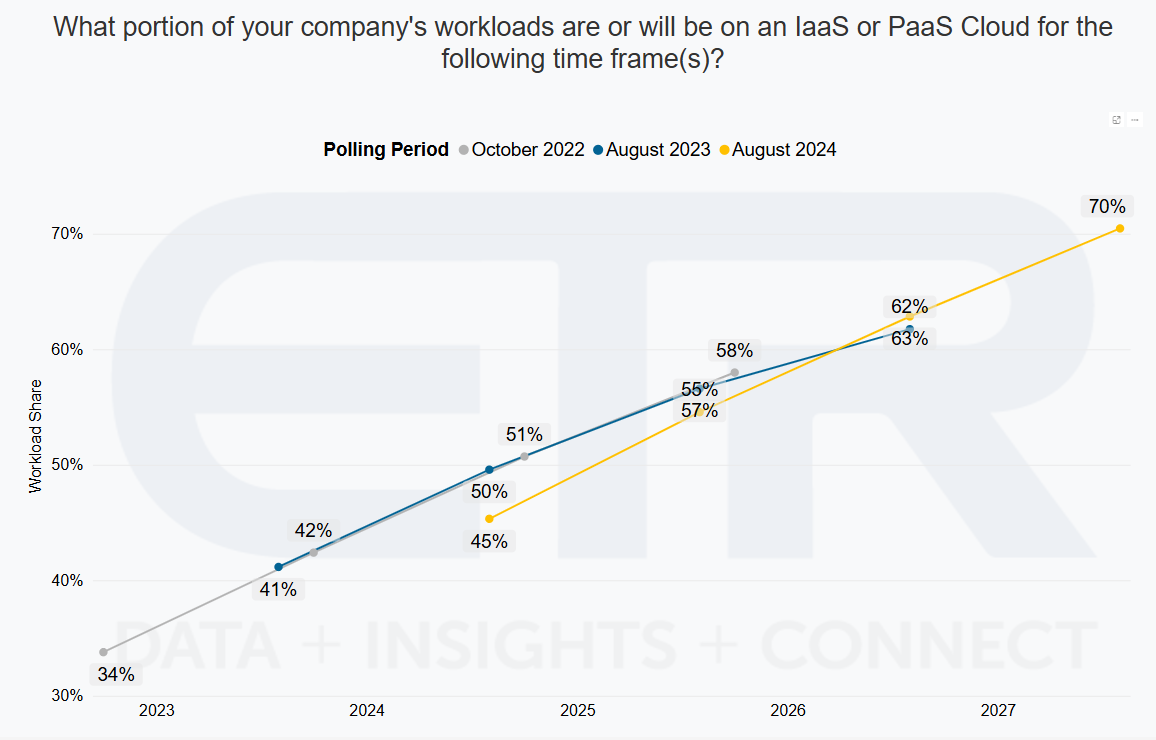
ETR Data: According to data collected in August 2024, the average workload share in the cloud was 55%, slightly below predictions from a year earlier. However, respondents have course corrected, now expecting their organization's proportion of cloud workloads to increase at a greater rate than prior estimates with 63% of all organizational workloads expected be in the cloud by August 2026, and 70% August 2027.
Security is another cornerstone of our guest's strategy, utilizing tools like Microsoft Defender, Zscaler, and Check Point to ensures their cloud environments are protected against evolving risks: "We are very particular about how we expose our applications in the public cloud, with no public Internet exposure. Everything has to go through 15 or 16 different reviews before we put that first application in the cloud."
Meanwhile, the enterprise is embracing AI cautiously, with a focus on practical tools like Dataiku and Databricks: "Dataiku helps democratize data science for business users, enabling them to derive insights without needing a specialized academic background. Databricks, on the other hand, offers scalability and advanced capabilities."
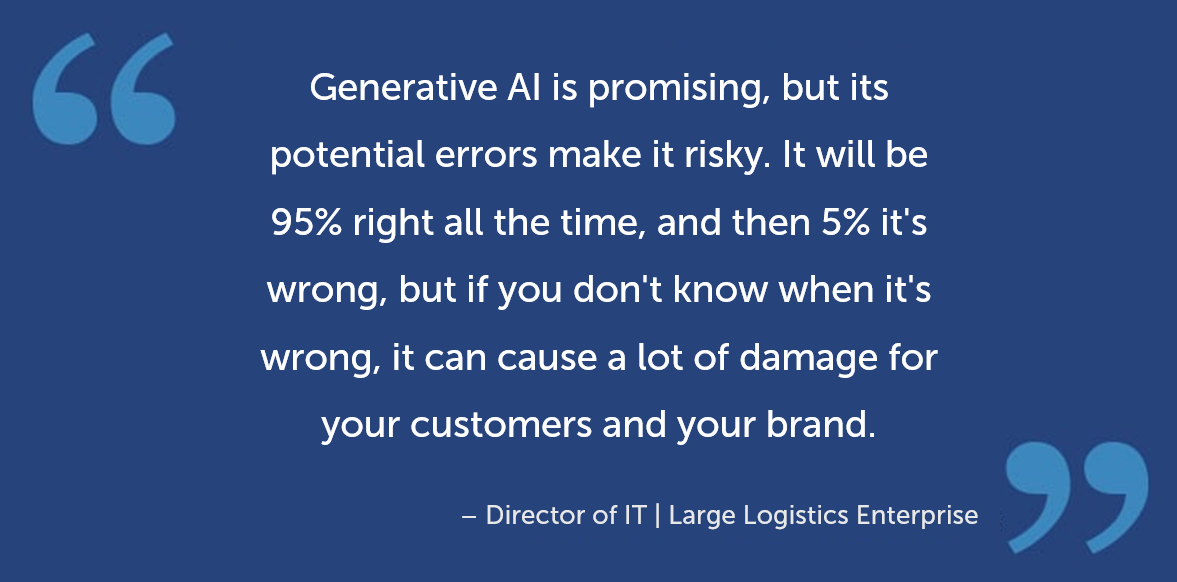
Generative AI remains in the proof-of-concept phase, with concerns over unpredictability and risk management: "Generative AI can save money on vendors and operational efficiencies, but it must be self-funded and self-supported. We need stringent controls to mitigate potential risks."
The shift toward cost-efficient workforce strategies adds another layer to this transformation. By moving operations to Tier 2 and Tier 3 cities like Pune and Chennai, the company has found a balance between talent acquisition and cost management: "In Tier 2 and Tier 3 cities, we get the same talent at more economical pricing, which helps us scale affordably while reducing dependency on major urban hubs."
To dive deeper into this interview and access ETR's full Transcript Library, reach out to your ETR service rep today! Stay ahead of the market with actionable insights into vendor performance.
Enterprise Technology Research (ETR) is a technology market research firm that leverages proprietary data from our targeted IT decision maker (ITDM) community to provide actionable insights about spending intentions and industry trends. Since 2010, we have worked diligently at achieving one goal: eliminating the need for opinions in enterprise research, which are often formed from incomplete, biased, and statistically insignificant data. Our community of ITDMs represents $1+ trillion in annual IT spend and is positioned to provide best-in-class customer/evaluator perspectives. ETR’s proprietary data and insights from this community empower institutional investors, technology companies, and ITDMs to navigate the complex enterprise technology landscape amid an expanding marketplace. Discover what ETR can do for you at www.etr.ai