In ETR's recent interview with the Head of Data and AI Transformation at a global insurance enterprise, our guest described the innovative technologies they are using to modernize operations and the strategy behind it. With a doubled IT budget, the company is focused on balancing generative AI adoption, scaling RPA, and working with vendors like Snowflake, Databricks, and Automation Anywhere. Below, review key takeaways and supporting commentary from the call.
1. Generative AI is Already Delivering Value. Our guest is using ChatGPT and similar solutions in production for tasks like meeting summaries, marketing content creation, and translation. These tools have provided immediate gains in operational efficiency, though financial ROI remains a longer-term goal. "We also have financial analysis use cases which are being tested for the moment. For the use cases in production, we already generate value. These include meeting summaries, text synthesis, and translations, [which provide operational benefits quickly but require further refinement for financial ROI]."
2. Snowflake and Databricks Address Different Needs. Snowflake excels in accessibility and its extensive data marketplace, making it ideal for business users, while Databricks offers more flexibility for technical teams requiring autonomy in advanced workflows. "Snowflake also has a data marketplace feature and capacity, which is quite well-developed. The number of data sets offered by Snowflake is way, way higher… On Databricks, you keep this autonomy and possibility to escape, at least a little bit more than with Snowflake."
3. Automation Anywhere Simplifies Operations. As the centerpiece of our guest's RPA strategy, Automation Anywhere delivers scalability and process customization, allowing the organization to streamline repetitive tasks across diverse business functions. "Automation Anywhere… is so customizable. It sort of fits in very well with a variety of different business functions. While the interface isn’t the most polished, it plays a critical role in automating repetitive tasks and scaling across the organization."
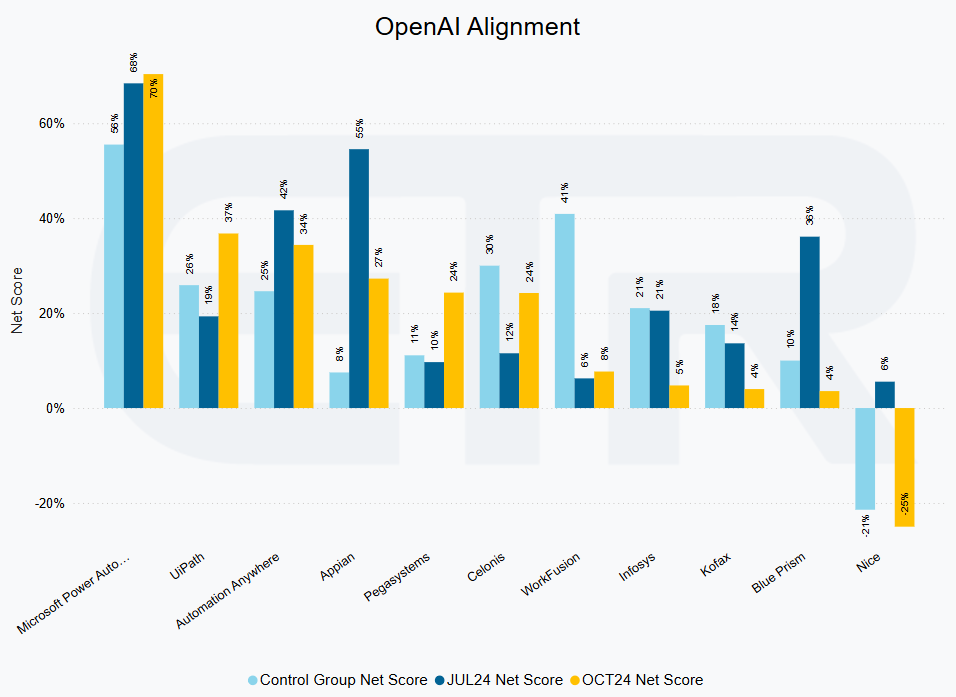
ETR Data: According to data from ETR's most recent Technology Spending Intentions Survey (TSIS), Automation Anywhere's net spending velocity is greater among respondents that are also customers of Open AI than among all respondents, trailing Microsoft Power Automate and UiPath. Contrary to earlier sentiment that the rise of generative AI would inhibit spending on RPA, more recent data shows strengthening RPA spend, hinting at a more mutually beneficial relationship between the two technologies.
4. Hallucinations and Data Leakage Are Top Risks. The company has implemented strict governance frameworks to address critical AI risks like hallucinations and data leakage, ensuring compliance with GDPR and protecting their reputation. "The highest risks are hallucinations and data leakage. If you use content which is totally wrong, then you face operational risks that can result in financial or reputational risks… Data leakage is also reputational and can be very high impact."
5. User Education Drives AI Adoption. Structured learning initiatives have driven an 80% adoption rate of their GPT-like QA solution, equipping employees with essential knowledge of generative AI concepts like LLMs and chatbots. "We reached 80% adoption in five or six months. We performed a lot of education to ensure people were familiar with the tools. Now, most of the key terms around generative AI—such as LLMs, chatbots, tokens, and prompts—are known and understood by most of our colleagues, at least from a high-level perspective."
Like what you see? There's so much more where that came from. Head over to the ETR Platform to access the full set of research content from this interview, and hundreds more, in the ETR transcript library.
Enterprise Technology Research (ETR) is a technology market research firm that leverages proprietary data from our targeted IT decision maker (ITDM) community to provide actionable insights about spending intentions and industry trends. Since 2010, we have worked diligently at achieving one goal: eliminating the need for opinions in enterprise research, which are often formed from incomplete, biased, and statistically insignificant data. Our community of ITDMs represents $1+ trillion in annual IT spend and is positioned to provide best-in-class customer/evaluator perspectives. ETR’s proprietary data and insights from this community empower institutional investors, technology companies, and ITDMs to navigate the complex enterprise technology landscape amid an expanding marketplace. Discover what ETR can do for you at www.etr.ai