Nearly 1,700 IT decision makers participated in ETR's 15th quarterly Macro Views survey covering high-level IT spend trends and organizational changes. The Macro Views report highlights data analysis from our ITDM community weighing in on IT budgets, spending priorities, hiring trends, cloud workloads, remote work, vendor-specific impact, and much more. This week we wrap up our two-part series by reviewing the top overall IT priorities with in-depth looks into information security, data analytics, and cutting-edge data analyzing the business use cases for open generative AI and large language models.
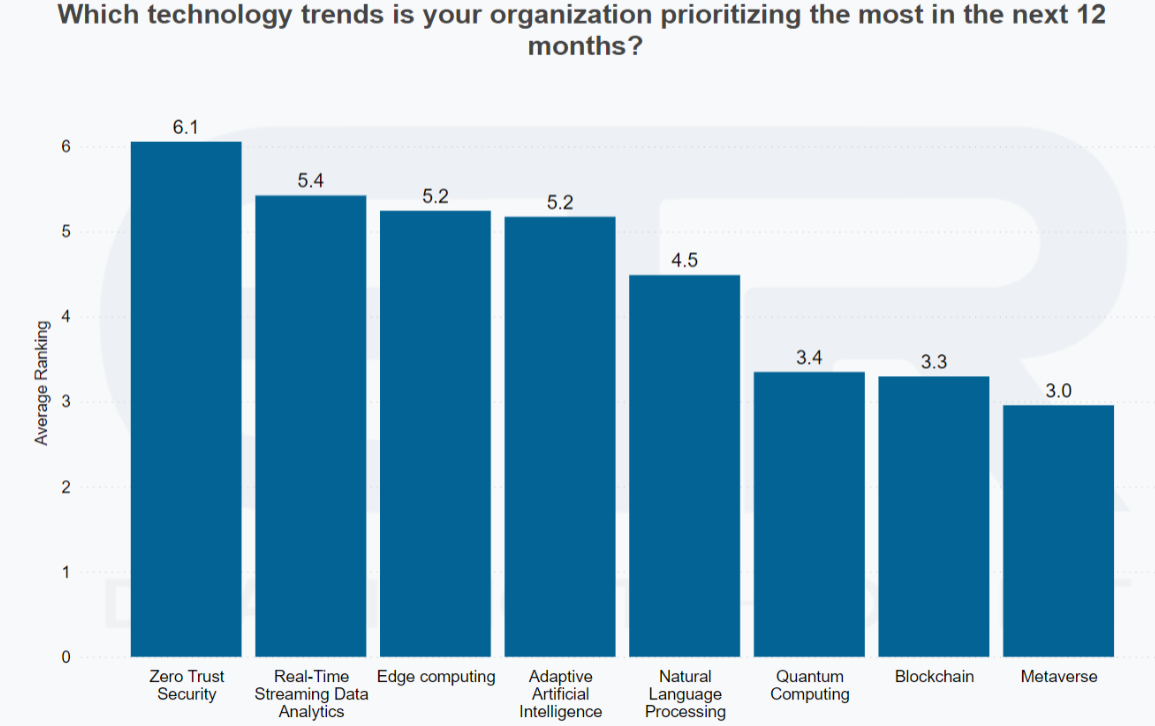
Let's begin with overall IT priorities. Leveraging the recent ETR Insights 2023 Top Technology Trends series, we asked respondents to rank their top spending priorities over the next twelve months, and Zero Trust Security is being prioritized the most by a wide margin. Real-Time Streaming Data Analytics, Edge Computing, and Adaptive Artificial Intelligence followed in priority rankings, with Metaverse, Blockchain, and Quantum Computing as the lowest priorities.
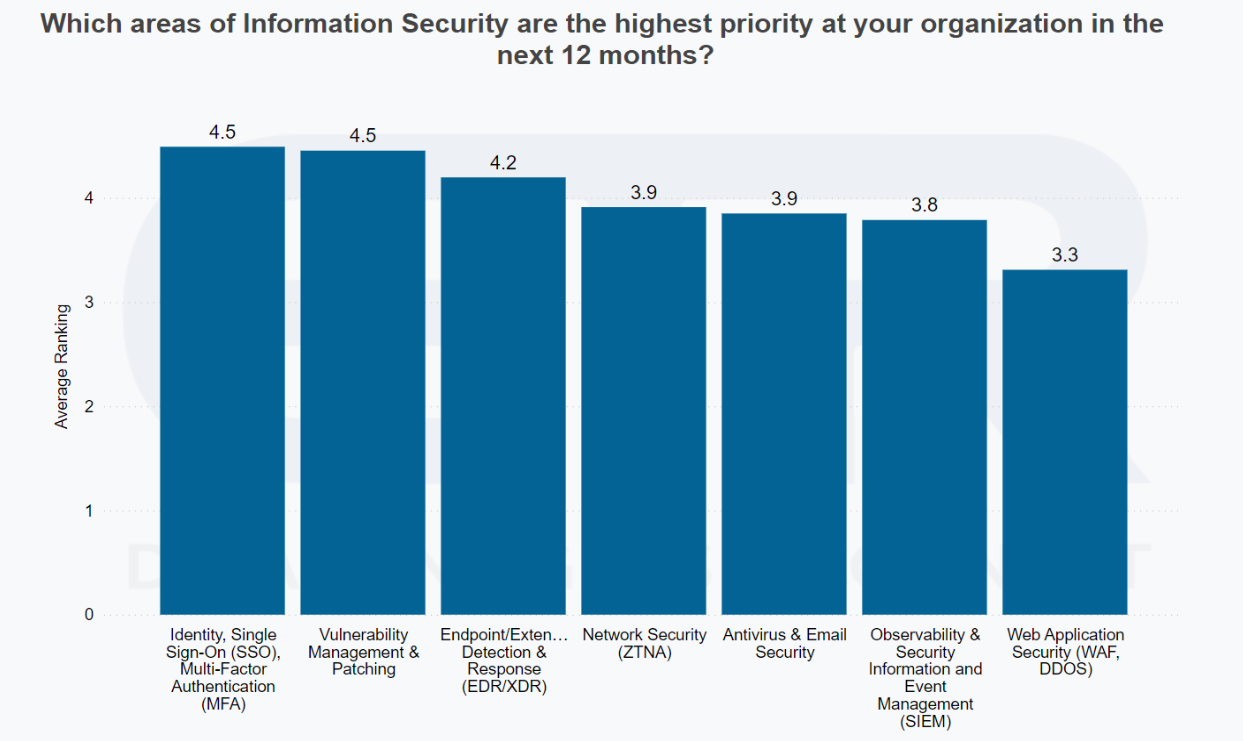
Going one level deeper, we followed up on which specific areas of Security and Data Analytics were being prioritized. Within Security, the results below showed Identity Access Management (SSO, MFA, etc.) and Vulnerability Management & Patching are tied as the highest-priority areas within security, followed by EDR/XDR. Web Application Security (WAF, DDoS) is the lowest priority based on the recent survey data.
While one would fully expect Identity Access and EDR/XDR to be at the top based on the elevated Net Scores of the vendors playing in the space (especially leaders like Okta, Auth0, CyberArk, and Crowdstrike), the high ranking of Vulnerability Management is interesting. On one hand, asset management and patching are of the utmost importance and considered mandatory security hygiene in any CISO playbook; however, on a vendor level, the three main players (Qualys, Rapid7, and Tenable) are seeing consistently lower Net Scores as ITDM's have noted a commoditization of the technology. In addition, pressure from other vendors pushing into this core functionality (Tanium, SentinelOne, and Crowdstrike) is adding pressure to the main trio of vendor options. This seems to be a case where the importance of the operation exceeds the value of the individual solution provider, according to the data.
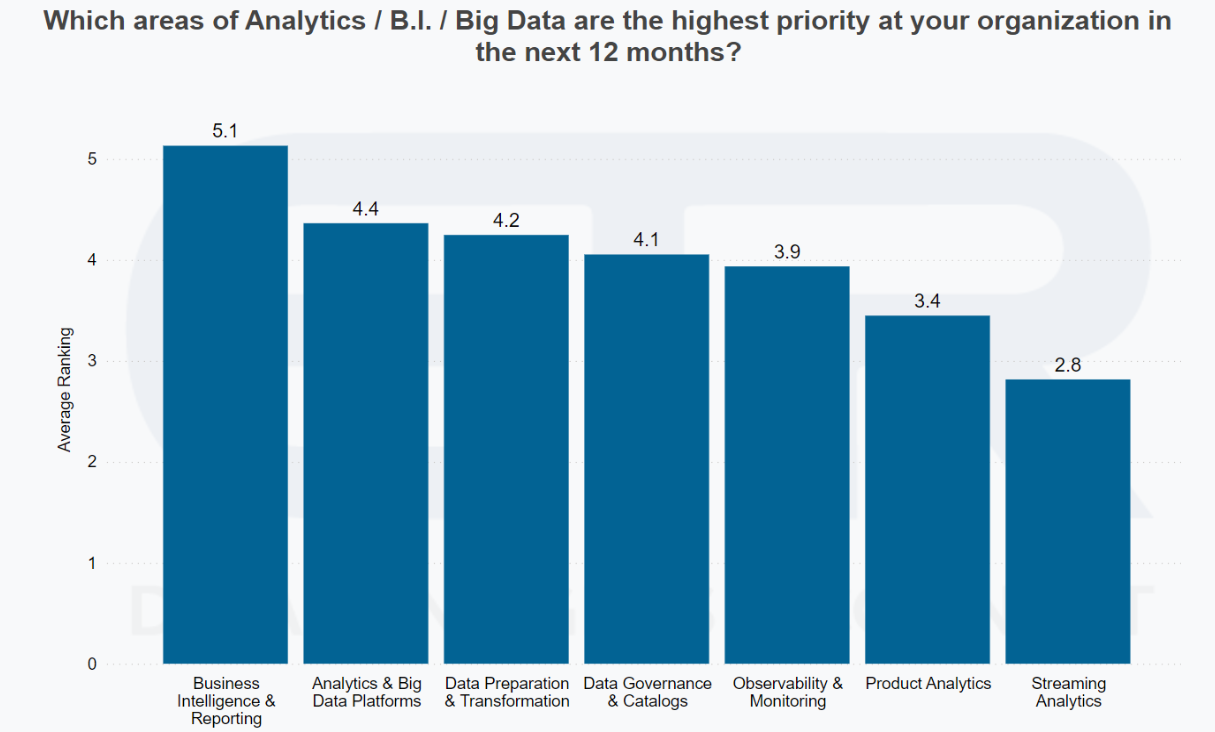
Transitioning to the Analytics / B.I. / Big Data sector, Business Intelligence & Reporting is the highest priority by a considerable margin. Big Data Platforms, Data Preparation & Transformation, and Data Governance & Catalogs are tightly grouped as the following priority areas, while Streaming Analytics is the lowest priority area, along with Product Analytics (see data visualization below).
Wrangling data for traditional business reporting has long been a task for technical professionals in IT departments, requiring moderate or advanced knowledge of SQL, an understanding of how to build ETL pipelines between different data sources, and other technical skills beyond the grasp of a typical business analyst. A move to business-driven, self-service business intelligence in the past decade was brought about by the rise of visual and relatively non-technical tools like Salesforce’s Tableau, Qlik, and Microsoft’s Power BI. These tools ushered in a new era of data and analytics that saw business users taking more control of building not only reports and dashboards but also some data management and data preparation tasks.
With this came a new class of user-friendly, relatively non-technical data preparation tools. These tools often abstract away the need for a user to know much, if any, SQL, and can be as easy-to-understand as manipulating a spreadsheet or dragging and dropping boxes and arrows to build highly visual data pipelines depicting complex joins and unions of data from different sources. Stand-alone tools like Alteryx, Trifacta (which Alteryx acquired), Paxata, Matillion, Zoho, Talend, and Hitachi’s Pentaho offer these capabilities for data preparation for analytics or for larger-scale ETL operations. Recent data on several of these vendors, however, have not been kind, and spending intentions are on the decline for some of these leading brands.
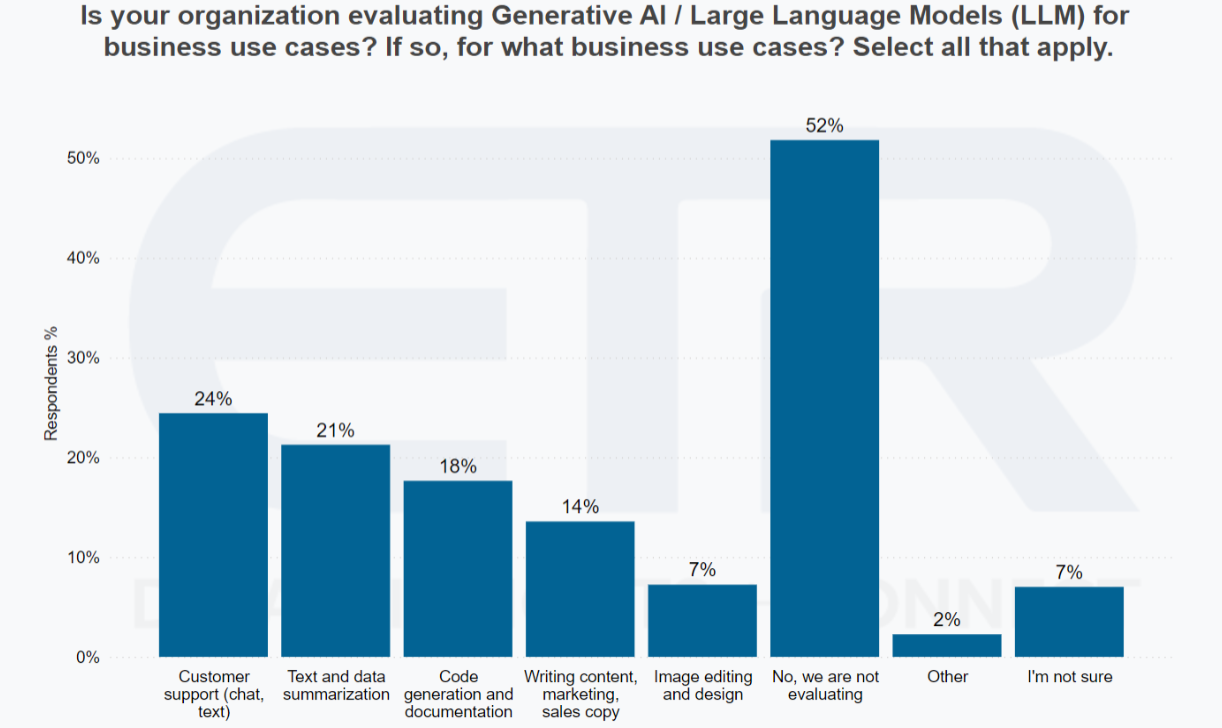
Lastly, given the potential impact (and headline dominance) of Generative AI, we queried our ITDMs about their projected usage of the technology and found that the majority (52%) of organizations are not currently evaluating Generative AI / Large Language Models (LLMs) for business use cases. Clearly this is contrary to the majority of news outlet reporting and the general hype cycle, and with the developments and vendor announcements around the technology developing so rapidly, ETR will continue to gather data on the subject. Among those that are currently evaluating Generative AI / LLMs, customer support and text and data summarization were the most common use cases. Image editing and design were the least frequently cited use cases (see below).
If you would like to read more about the subject, check out ETR's report on OpenAI's sentiment data and early adoption of the technology among our ITDM community, written back in March. In addition, the May 2023 Emerging Technology Survey (ETS) is currently in the field, with more than 1,000 responses already collected. Check out OpenAI's dominant Evaluation rates in the ETS data.
Your own free trial is just one click away...no strings attached. Come check out the 12 years' worth of data and industry-leading research that ETR has to offer. See you next week!
Enterprise Technology Research (ETR) is a technology market research firm that leverages proprietary data from our targeted IT decision maker (ITDM) community to provide actionable insights about spending intentions and industry trends. Since 2010, we have worked diligently at achieving one goal: eliminating the need for opinions in enterprise research, which are often formed from incomplete, biased, and statistically insignificant data. Our community of ITDMs represents $1+ trillion in annual IT spend and is positioned to provide best-in-class customer/evaluator perspectives. ETR’s proprietary data and insights from this community empower institutional investors, technology companies, and ITDMs to navigate the complex enterprise technology landscape amid an expanding marketplace. Discover what ETR can do for you at www.etr.ai